Consider a regular
octagon, inscribed in a circle of radius R
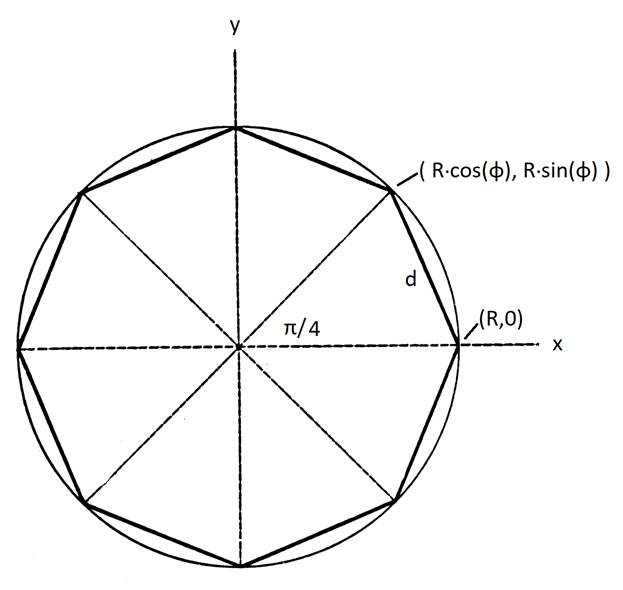
φ = π/4
d2 = (x2 – x1)2 + (y2 – y1)2 [ ask Mr. Pythagoras ]
d2 = (R - Rcos(φ))2 + R2sin2(φ)
d2 = R2 - 2R2cos(φ) + R2cos2(φ) + R2sin2(φ)
d2 = R2( 1 + cos2(φ) + sin2(φ)) - 2R2cos(φ)
d2 = 2R2 - 2R2cos(φ)
d = R SQRT( 2 - 2cos(φ) )
Thus, the octagon’s perimeter is P = 8d, or
P = 8R SQRT( 2 - 2cos(φ) )
Now consider a regular polygon with n8
sides
φn = 2π/(8n),
where n = 1, 2, 3, 4, …
Pn = 8nR SQRT( 2 - 2cos(2π/(8n)) )
Note: if n
>> 1 then 2π/(8n) << 1
Let us look at the cosine function
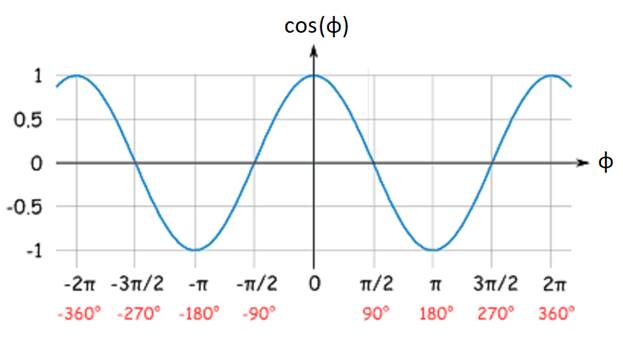
Consider this approximation for cos(φ) near φ = 0
cos(φ) = 1 − φ2/2! + φ4/4!
− φ6/6! + φ8/8!
− …
Note: there are no terms like φ,
φ 3, φ5,
…
because
cos(-φ) = cos(φ)
Then, with
cos(φ) = 1 − φ2/2! + φ4/4!
− φ6/6! + φ8/8!
− …
and for φ << 1,
( 2
- 2cos(φ) ) ≈ φ2
Then,
with φ = φn = 2π/(8n)
Pn = 8nR SQRT( 2 -
2cos(2π/(8n)) ) becomes
Pn ≈ 8nR(2π/(8n)) ) = 2πR
and if n >> 1,
then Pn ≈ 2πR is the
circumference of the circle. Surprise !!